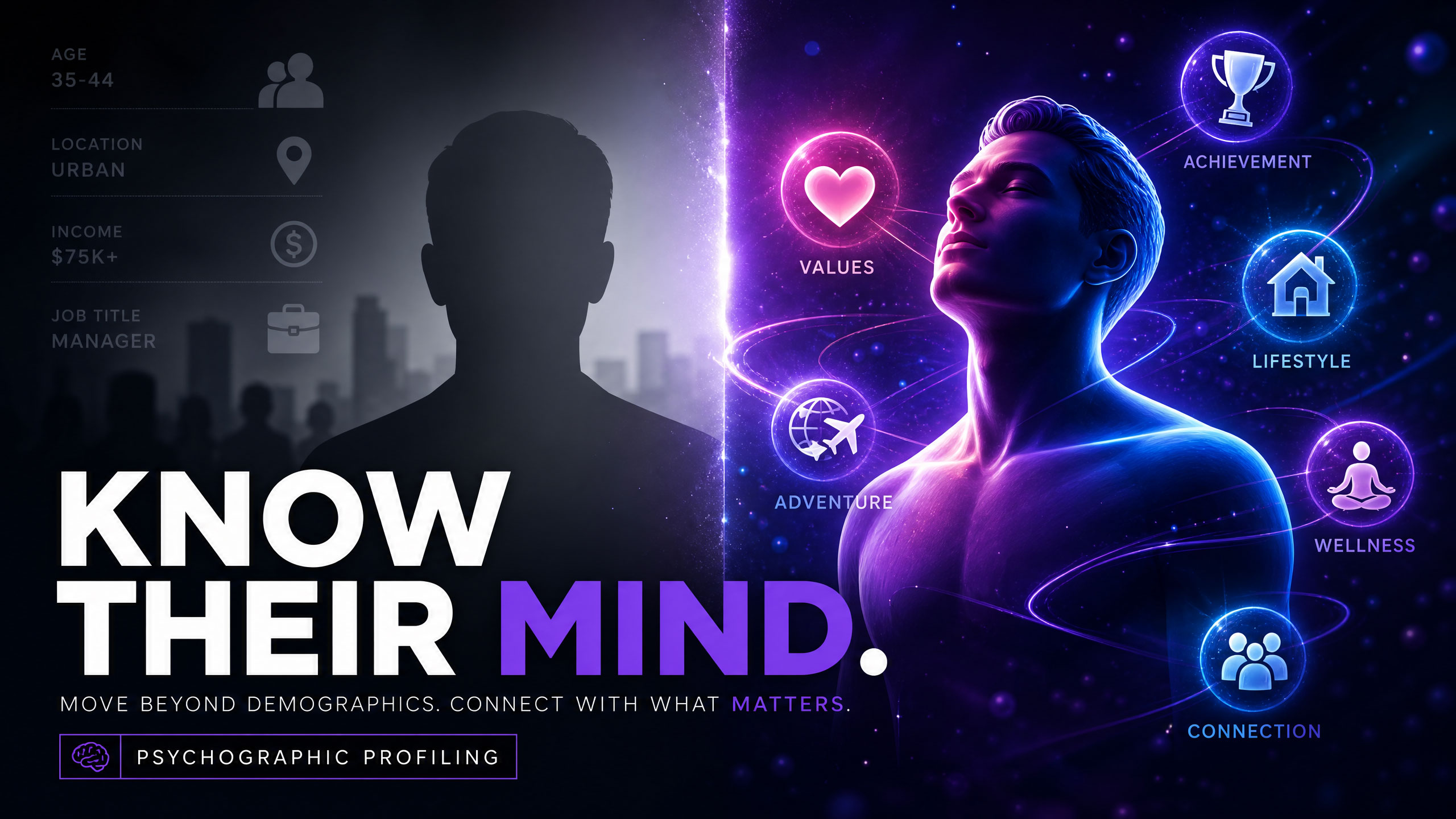
Are you still building your marketing strategy around “women aged 35-50 who earn $75k a year”?
If so, you are operating in the dark.
Demographics tell you who your customer is. But they never tell you why they buy.
If you want to stop guessing and start converting, you must move beyond basic data. You must master Psychographic Profiling.
The Trap of Surface-Level Data
Most business owners think they know their audience. They look at their Google Analytics. They see age, location, and income.
Then they launch an ad campaign and hear crickets.
Why? Because a 40-year-old mother of two making $100k in the suburbs could be a stressed-out executive desperate for time-saving shortcuts. Or she could be a health-obsessed yogi who spends her weekends at farmer’s markets.
Demographically, they are identical. Psychographically, they are completely different people.
If you try to sell to both of them with the exact same message, you will fail. You are wasting your marketing budget on a generalized message that connects with no one.
The Secret to Deep Connection
Psychographics are the psychological attributes of your customer. It is their values, desires, goals, interests, and lifestyle choices.
When you understand a customer’s psychographics, you stop selling products. You start selling solutions to their deepest desires.
Here is the three-step framework I use to help businesses build psychographic profiles that actually convert.
1. Identify Their Core Values
What does your ideal customer believe in? Do they value prestige and status? Do they value frugality and practicality? Do they value environmental sustainability?
If your product is a premium, high-priced service, but you are marketing it to people who value extreme frugality, you will never close the deal.
You must align your brand’s messaging with the core values of your target audience. When your values match theirs, trust is built instantly.
2. Map Their Daily Lifestyle
You need to know what a Tuesday looks like for your best customer.
Are they waking up at 5 AM to hit the gym before a chaotic corporate commute? Are they working from home, juggling Zoom calls and toddlers?
When you understand their daily lifestyle, you understand where your product fits into their world. You stop selling a feature and start selling a seamless integration into their life.
3. Pinpoint Their Secret Aspirations
Everyone has a stated goal and a secret aspiration.
The stated goal is: “I want to lose 10 pounds.” The secret aspiration is: “I want to walk into my high school reunion and make my ex jealous.”
Your marketing must speak to the secret aspiration. That is where the emotional trigger lies. When you can articulate what they really want better than they can articulate it themselves, they will hand you their credit card.
Laser-Targeted Marketing
When you master psychographic profiling, your entire business shifts.
Your copywriting practically writes itself. You know exactly what words to use, what fears to agitate, and what outcomes to promise.
Your ad costs plummet because you are no longer paying to show ads to people who will never buy. You are speaking directly to the exact people who are primed and ready for your offer.
Imagine launching a campaign and watching the leads pour in because your message resonated on a visceral, emotional level. Imagine building a brand that feels like it was custom-made for your ideal buyer.
That is the power of psychographics. It turns a shot in the dark into a sniper rifle.