Are you putting all your energy into getting new leads, but your revenue still isn’t growing?
If your sales funnel is a black box — leads go in, but you have no idea what happens next — you have a massive leak.
You are losing customers at multiple stages of the buying process. And because you cannot see where the leak is, you cannot fix it.
If you want to build a business that converts consistently and retains customers for life, you must master Customer Journey Mapping.
The Illusion of the Straight Line
Most business owners think the customer journey is simple: they see your ad, they visit your website, they buy.
That is not how it works.
The modern customer journey is messy. A prospect might see your Instagram post, then forget about you for two weeks, then Google your name, then read your reviews, then watch a YouTube video, then finally visit your website and buy.
If you are only optimizing the last step — the website — you are ignoring every single touchpoint that led them there. And you are probably losing them at one of those earlier stages.
Map Every Step of the Experience
A Customer Journey Map is a visual representation of every interaction a customer has with your brand, from the moment they first hear your name to the moment they become a raving fan.
Here is the three-step framework to build a map that reveals your hidden revenue leaks.
1. Define the Five Core Stages
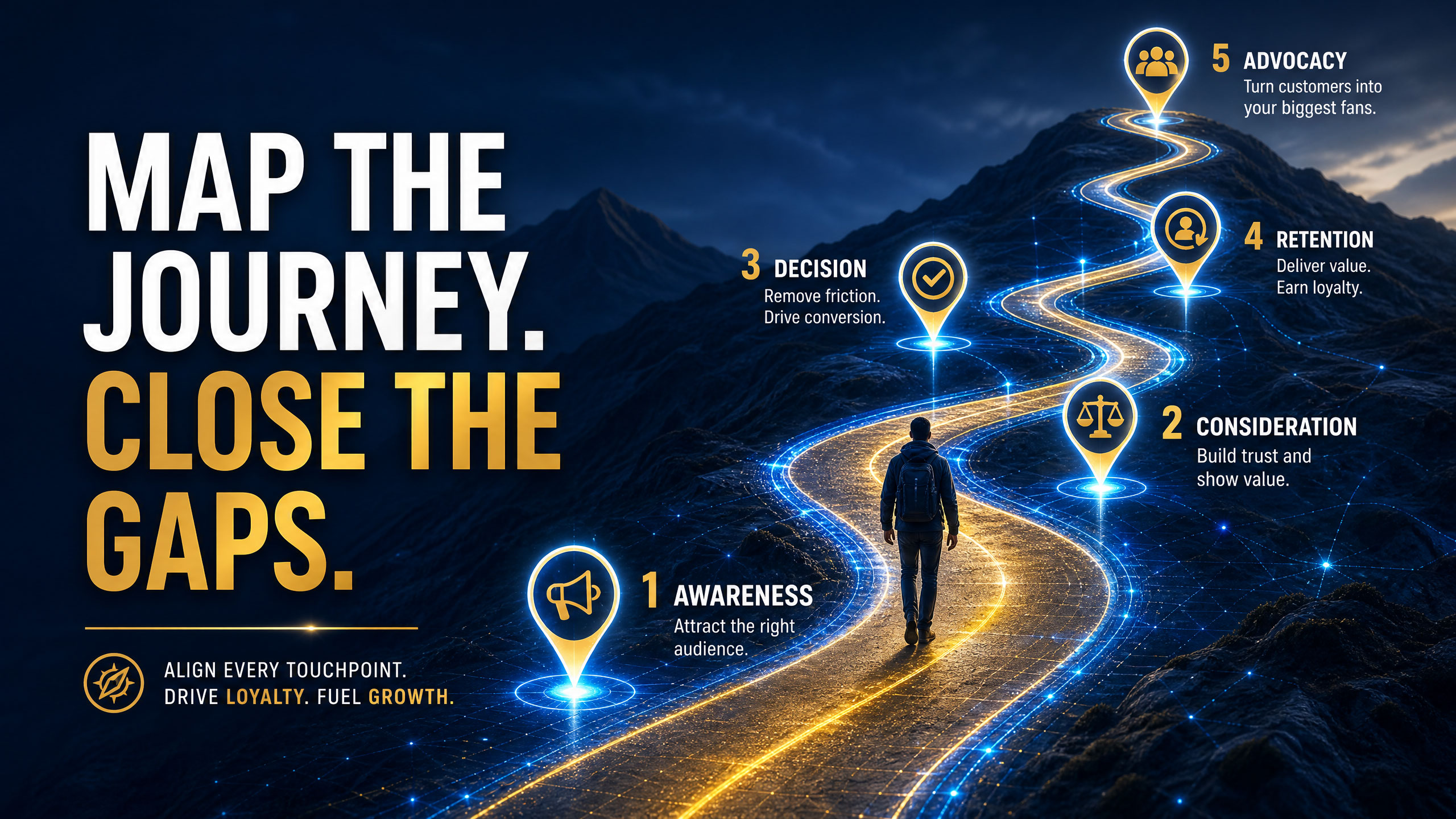
Every customer journey has five fundamental stages: Awareness, Consideration, Decision, Retention, and Advocacy.
Awareness is when they first discover you. Consideration is when they are evaluating their options. Decision is when they choose to buy. Retention is when you keep them coming back. Advocacy is when they start telling their friends about you.
You must have a deliberate strategy for each stage. If you are only focused on the Decision stage, you are neglecting the four other stages where you are hemorrhaging potential revenue.
2. Identify the Emotional State at Each Stage
At every stage of the journey, your customer is feeling something specific.
At the Awareness stage, they are curious. At the Consideration stage, they are skeptical. At the Decision stage, they are anxious.
Your marketing must match the emotional state of the stage. Sending a hard sales pitch to someone in the Awareness stage is like proposing marriage on the first date. You will scare them away.
3. Pinpoint the Friction Points
Walk through your own customer journey as if you were a first-time prospect.
Try to find your business on Google. Read your own reviews. Navigate your website on a mobile device. Attempt to check out.
Where did you get frustrated? Where did you feel confused? Where did you feel a lack of trust?
Those friction points are costing you money every single day. Fix them.
A Frictionless Path to Revenue
When you map and optimize your customer journey, your entire business becomes more efficient.
You stop losing customers to friction and confusion. You guide them smoothly from stranger to buyer to loyal advocate.
Imagine knowing exactly which stage of your funnel needs attention. Imagine fixing one friction point and watching your conversion rate jump by 30%.
That is the power of customer journey mapping. It gives you a bird’s-eye view of your entire business and shows you exactly where to focus your energy.