Are you launching products and services based on what you think your customers want?
If you are making major business decisions based on gut instinct and assumptions, you are gambling with your revenue.
You might get lucky once or twice. But eventually, you will invest months of time and thousands of dollars into something the market does not want.
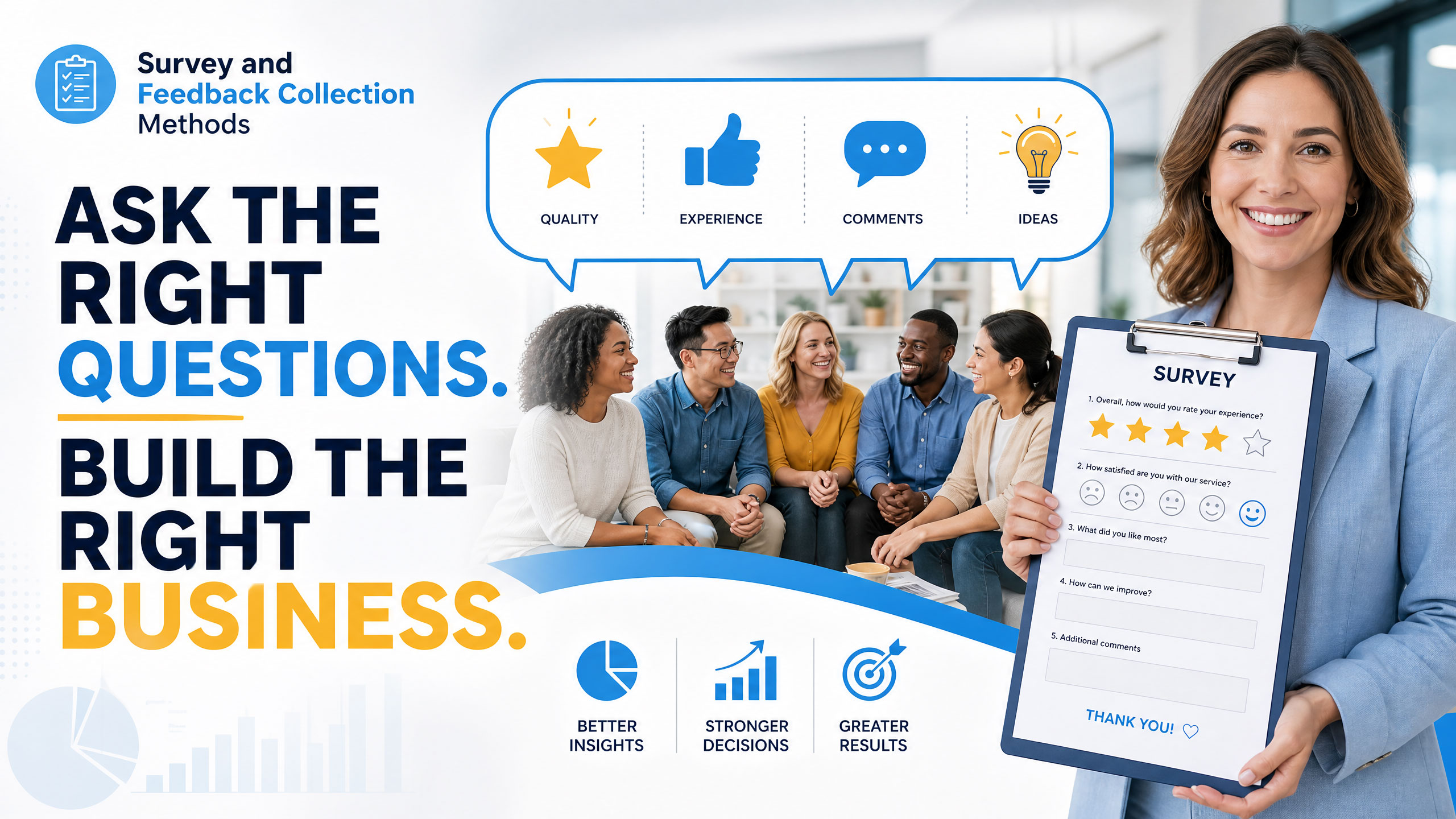
If you want to build a business that consistently delivers what customers actually need, you must master Survey and Feedback Collection Methods.
The Assumption Trap
Most business owners are in love with their own ideas. They come up with a concept, they get excited, and they assume the market will share their enthusiasm.
They skip the research phase. They skip the validation. They go straight to building.
Then they launch… and the market shrugs.
This is not a product problem. This is a research problem.
The most successful businesses in the world are not run by the best visionaries. They are run by the best listeners. If you want to build something people will pay for, you must first learn to ask the right questions.
Build a Feedback Machine
Collecting feedback is not about sending out a generic survey once a year and hoping for the best. It is about building a systematic process that continuously feeds you the data you need to make smart decisions.
Here is the three-step framework to build a feedback machine that drives revenue.
1. Ask Open-Ended Questions That Reveal Real Emotion
Most surveys are useless because they ask the wrong questions.
“On a scale of 1 to 10, how satisfied are you?” tells you almost nothing.
Instead, ask questions like: “What was your biggest frustration before you found us?” and “What almost stopped you from buying?” and “In your own words, what has changed since you started using our product?”
These open-ended questions give you the exact language your customers use to describe their pain and their transformation. That language becomes the foundation of all your marketing copy.
2. Time Your Feedback Requests Strategically
The timing of when you ask for feedback is just as important as what you ask.
Ask for feedback immediately after a purchase, when the excitement is high. Ask for feedback 30 days after purchase, when they have had a chance to experience the product. Ask for feedback after a customer service interaction, when the experience is fresh.
Different timing reveals different insights. A new customer will tell you what convinced them to buy. A 30-day customer will tell you what is working and what is not.
3. Create a Safe Space for Honest Criticism
People will not tell you the truth if they think it will hurt your feelings.
Make it explicitly clear that you want honest, unfiltered feedback. Tell them that negative feedback is the most valuable feedback you can receive.
Consider using anonymous surveys for sensitive topics. The more psychologically safe you make the process, the more honest and actionable the data will be.
A Business Built on Reality
When you build a systematic feedback collection process, you stop making expensive assumptions.
You know exactly what your customers love, what they hate, and what they desperately wish you offered. You can launch new products with confidence because you have already validated the demand.
Imagine never wasting money on a product launch that misses the mark. Imagine using your customers’ own words in your marketing and watching your conversion rate soar because prospects feel like you are reading their minds.
That is the power of strategic feedback collection. It turns your customers into your research and development department.