Are you making major marketing decisions based on gut feeling?
If you cannot tell me your cost per lead, your customer acquisition cost, or your best-performing traffic source, you are flying blind.
You are spending money on marketing activities and hoping for the best.
Hope is not a strategy.
If you want to make confident, profitable marketing decisions, you must master Analytics and Performance Tracking.
The Trap of Vanity Metrics
Most business owners love to talk about their social media followers, their website page views, and their email open rates.
These are vanity metrics. They feel good. They look impressive in a report. But they do not tell you whether your marketing is actually making you money.
A business with 50,000 Instagram followers and zero sales is a hobby. A business with 500 Instagram followers and a 10% conversion rate is a profitable enterprise.
You must stop measuring what is easy to measure and start measuring what matters.
Measure What Moves the Needle
The purpose of analytics is not to collect data. It is to make better decisions.
Here is the three-step framework to build a performance tracking system that actually drives revenue.
1. Define Your North Star Metrics
You cannot track everything. You must identify the three to five metrics that have the most direct impact on your revenue.
For most businesses, these are: Cost Per Lead (CPL), Lead-to-Customer Conversion Rate, Customer Acquisition Cost (CAC), Customer Lifetime Value (CLV), and Return on Ad Spend (ROAS).
These are the numbers you must know by heart. These are the numbers you review every single week. If any of them move in the wrong direction, you have an early warning signal to investigate and fix.
2. Build a Single Source of Truth
The biggest problem with analytics is that data is scattered across too many platforms. Your ad data is in Google Ads. Your website data is in Google Analytics. Your email data is in your CRM.
You must consolidate this data into a single dashboard. Whether you use a tool like Google Looker Studio, HubSpot, or a custom spreadsheet, you need one place where you can see the full picture at a glance.
3. Create a Weekly Review Ritual
Data is useless if you never look at it.
You must build a non-negotiable weekly ritual where you review your key metrics, identify the trends, and make one data-driven decision to improve performance.
Is your CPL rising? Investigate your targeting. Is your conversion rate dropping? Investigate your landing page. Is your email open rate falling? Test new subject lines.
The weekly review turns data into decisions and decisions into revenue.
Confidence and Control
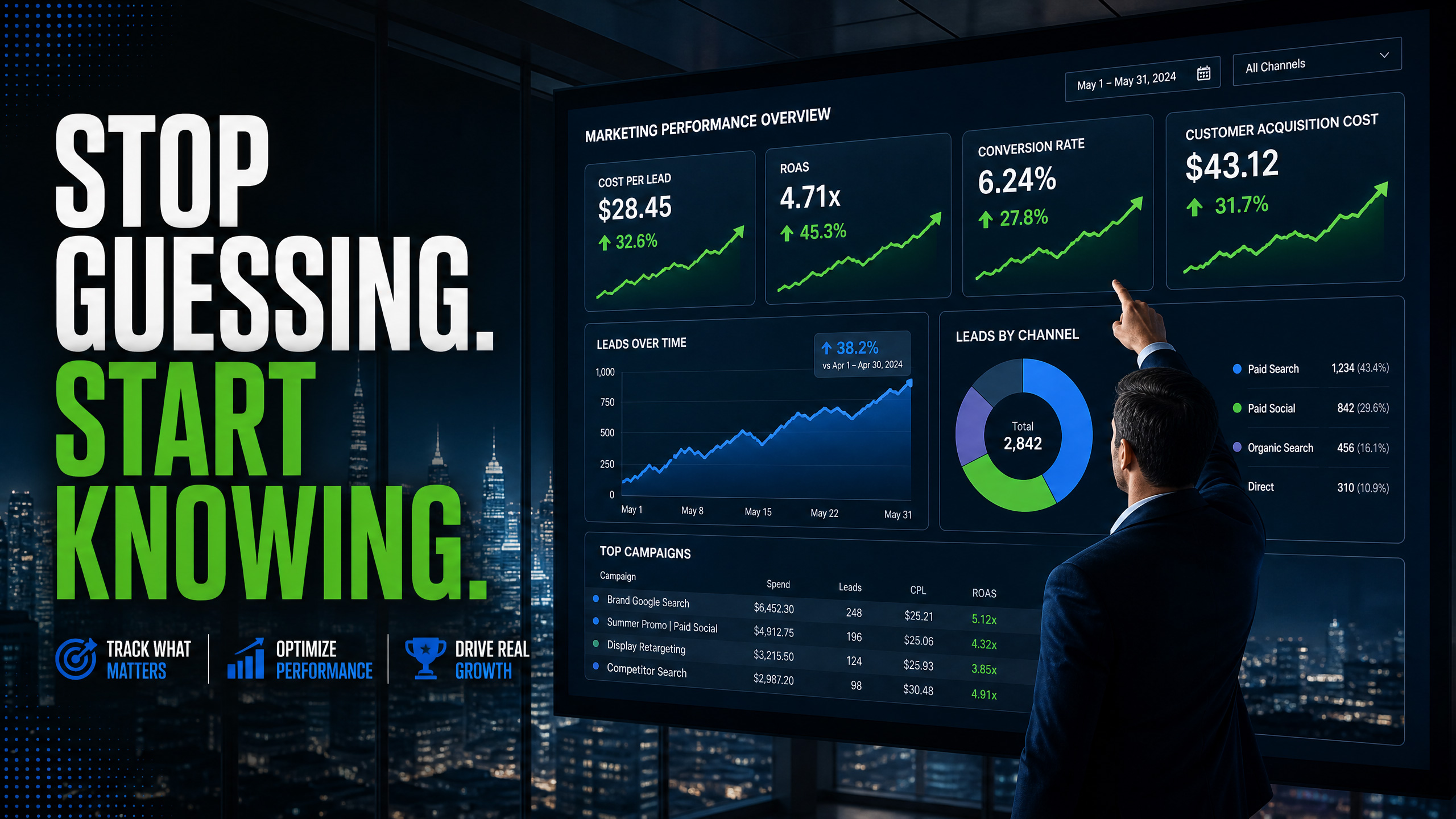
When you master analytics and performance tracking, you stop guessing and start knowing.
You can look at your marketing dashboard and know exactly which channels are profitable, which campaigns are underperforming, and where to invest your next marketing dollar.
Imagine having the confidence to scale your marketing budget because you know your exact return on every dollar spent. Imagine being able to identify a problem in your funnel and fix it before it costs you thousands.
That is the power of data-driven marketing. It turns your business from a gamble into a machine.