Many business owners struggle with marketing for one simple reason: they’re trying to sell to everyone.
When your message is designed for everyone, it resonates with no one. The result is wasted advertising dollars, low conversion rates, and constant frustration.
If you’ve ever said, “Anyone can benefit from my product or service,” you’re not alone. Unfortunately, that’s often the first sign that your marketing strategy lacks focus.
The most successful businesses know exactly who they serve, what problems they solve, and why customers choose them over competitors. That clarity begins with identifying your Ideal Customer Profile.
What Is an Ideal Customer Profile?
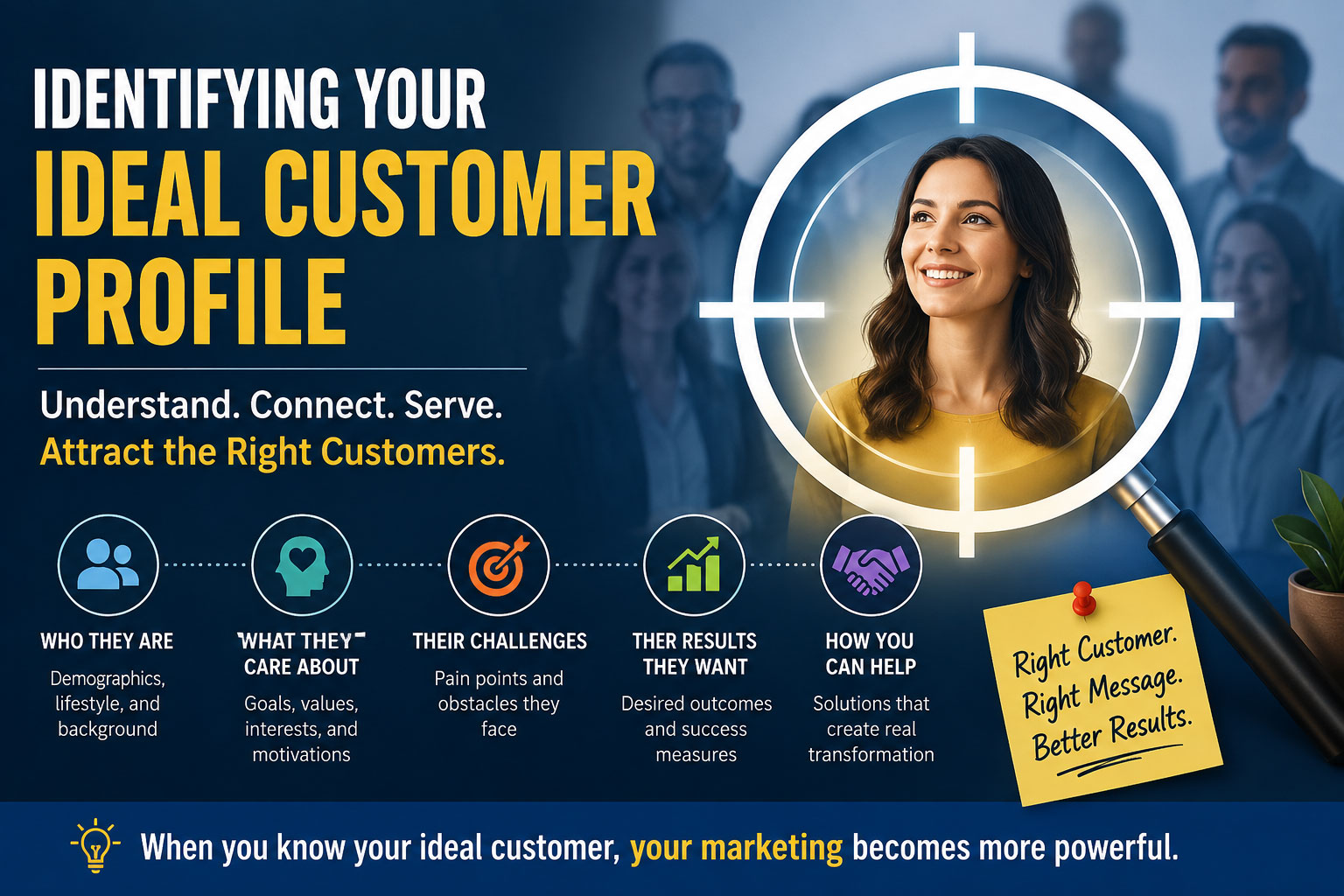
An Ideal Customer Profile (ICP) is a detailed description of the type of customer who receives the greatest value from your product or service while also generating the greatest value for your business.
Your ideal customer is not simply someone who can buy from you. It’s someone who is most likely to:
- Need your solution
- Appreciate your expertise
- Purchase quickly
- Refer others
- Become a repeat customer
The clearer your customer profile becomes, the easier every marketing decision becomes.
Why Most Businesses Get This Wrong
Many business owners focus on what they sell rather than who they serve.
They spend time refining products, improving services, and creating advertisements without first understanding the customer they’re trying to attract.
Imagine trying to hit a target in complete darkness.
That’s what marketing feels like when you don’t have a clearly defined customer profile.
Businesses that understand their ideal customer can create more relevant messaging, choose better advertising channels, and generate significantly higher returns on their marketing investment.
Start with Demographics
Demographics help identify who your customer is.
Consider factors such as:
- Age
- Gender
- Income
- Occupation
- Education level
- Marital status
- Geographic location
For example, a retirement planning advisor targeting individuals over age 50 will communicate very differently than a company selling products to first-time college students.
Demographics provide the framework, but they only tell part of the story.
Go Beyond Demographics and Explore Psychographics
Psychographics explain why customers make buying decisions.
Ask questions such as:
- What keeps them awake at night?
- What goals are they pursuing?
- What frustrations do they experience?
- What values are most important to them?
- What fears influence their decisions?
Two customers may be the same age and income level but make completely different buying decisions because their motivations differ.
Understanding those motivations allows you to speak directly to the emotions behind the purchase.
Identify Pain Points and Desired Outcomes
People buy solutions, not products.
Your ideal customer profile should clearly identify:
Current Problems
What challenges are they facing today?
Desired Results
What outcome are they trying to achieve?
Obstacles
What’s preventing them from reaching their goal?
When your marketing demonstrates a clear understanding of these factors, trust begins to develop immediately.
Customers naturally gravitate toward businesses that make them feel understood.
Analyze Your Best Existing Customers
One of the fastest ways to identify your ideal customer is to study the customers you already enjoy working with.
Ask yourself:
- Which customers generated the most profit?
- Which customers were easiest to work with?
- Which customers referred others?
- Which customers achieved the best results?
Patterns will quickly emerge.
You may discover that your best customers share similar demographics, motivations, industries, or buying behaviors.
Those patterns provide valuable clues for refining your customer profile.
Create a Customer Avatar
Once you’ve gathered enough information, create a detailed customer avatar.
Give this customer a name.
Describe their goals, frustrations, habits, concerns, and motivations.
The more specific you become, the easier it becomes to create advertisements, social media posts, email campaigns, and website content that feels personally relevant.
Great marketing often feels like a one-on-one conversation rather than a broadcast message.
The Competitive Advantage Most Businesses Ignore
Identifying your ideal customer profile isn’t just a marketing exercise.
It’s a strategic advantage.
Businesses that understand their customers deeply create stronger brands, attract higher-quality leads, close more sales, and build greater customer loyalty.
Before investing another dollar in advertising, take the time to clearly define who you’re trying to reach.
When you understand your ideal customer better than your competitors do, your marketing becomes more effective, your sales process becomes easier, and your business becomes significantly more profitable.
Frequently Asked Question
What is the biggest mistake businesses make when identifying their ideal customer?
The biggest mistake is creating a profile that is too broad. Successful marketing targets a specific audience with specific needs, challenges, and goals. The more clearly defined your ideal customer is, the more effective your marketing becomes.
Lastly
The goal of marketing is not to reach the most people. The goal is to reach the right people.
When you know exactly who your ideal customer is, every marketing decision becomes easier. Your messaging improves, your advertising becomes more efficient, and your business attracts customers who are more likely to buy, stay, and refer others.
The businesses that win in today’s marketplace are not necessarily the ones with the biggest budgets. They’re the ones with the deepest understanding of their customers.